
-

-
SIELC Primesep HPLC
Novel Stationary Phases
For decades, liquid chromatography stationary phase design has been dominated by the idea of elimination of multiple, or “unwanted”, interactions that occur in mixed-mode separations. Reverse-phase chromatography is making the point of eliminating silanol interactions with amine-containing analytes by developing base-deactivated phases.
Within the same trend, adsorption interactions are considered undesirable as opposed to steric interactions in size-exclusion chromatography, and non-ionic interactions are generally viewed as complications in ion-exchange and ion-exclusion chromatography.
However, there are ways to benefit from multiple interactions on the stationary phase. SIELC Technologies introduces Primesep® HPLC columns, specifically designed for mixed-mode separations and capable of separating a tremendous range of compounds by different separation modes based only upon mobile phase selection. MORE
Currently, SIELC Technologies offers the following types of silica-based mixed-mode phases.
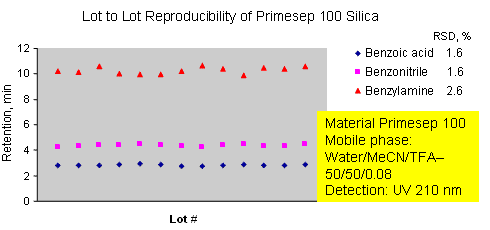
The main benefit of having more than one type of interaction on a column is the ability to provide separation even when one separation mode has failed. For example, while a typical reverse-phase column is unable to retain polar compounds without the addition of ion-pairing reagent, Primesep® columns with their ion-exchange retention separate wide range of polar compounds without any difficulty. Primesep® columns are designed with the understanding that proper inclusion, not elimination, of secondary interaction is a powerful tool in selectivity control, column stability, and separation reproducibility. Primesep® multi-step manufacturing process guarantees good reproducibility of retention of neutral, acidic and basic compounds. The plot below shows the consistency of performance achieved on 13 lots of the stationary phases synthesized from 3 different lots of silica gel during one year .
 Primesep® columns efficiently separate organic and inorganic ions in ion-exchange and ion-exclusion modes. They effectively work in normal and reverse phases, as well as in polar organic modes. Different modes of separation offer different selectivity. Working with Primesep® you won’t need an ion-pairing reagent in the mobile phase to separate ionizable polar compounds as these columns have an ion-pairing group embedded on a stationary phase. On the same column at the same time, an organic pharmaceutical can be quantified with its inorganic counter ion, or inorganic cations and anions can be run together without the ion-chromatography system. As opposed to reversed-phase columns, the selectivity of Primesep® columns can be altered not only by varying the concentration of the organic modifier, but also by changing the type and concentration of the acid modifier. These tools open a new realm of choices to alter the selectivity for the separation of various compounds previously unachievable.
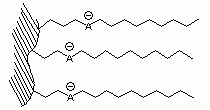
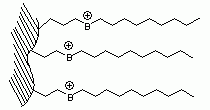
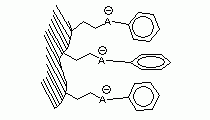
Every Primesep® column has a dual chemistry stationary phase with a hydrophobic long alkyl chain and an ionizable cationic or anionic embedded group. When the polar group bears a charge, it effectively shields any other less polar groups of the stationary phase. As a result, silanol groups, which cause unwanted interaction in many reverse-phase columns, are completely undetectable and do not affect the peak shape and selectivity.

|

|

|

|
||||||
|
|
|
|
||||||
|
Columns with negatively charged functional groups due to the embedded anionic ion-pairing reagent.
|
Columns with positively charged functional groups.
Primesep B
Primesep B2 |
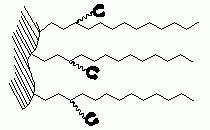
Column with unique unparallel selectivity.
Primesep C |
Three interactions within one column:
Primesep P |
||||||
| Choose the correct column by their functional group acidity to match the pKa value of your basic compounds. MORE |